
Hiten Parmar sits on La Fosse’s AI Workforce Council, the group of ten senior technology, data and security leaders helping to shape our Beyond Headcount Blueprint for the future workforce. He is Chief Procurement Officer at Beazley and has spent his career at the intersection of procurement and transformation.
Procurement is rarely part of the AI readiness conversation. We sat down with Hiten to ask why that is, and what it costs organisations trying to build AI capability.
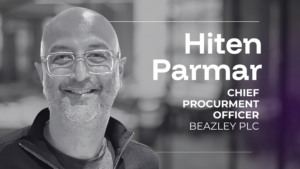
His answer, in his own words.
There’s a legacy view of what my function does. Procurement finds a vendor, agrees a contract, and walks away.
I’d ask one question of anyone who still thinks that way. In the end, what are you actually buying?
You’re buying talent. You’re buying capability and expertise. And when you buy those things you’re looking at far more than the equivalent of a CV. You’re looking at what that organisation has done, how it did it, how it collaborates with you, what its culture is, and where it’s going that you can’t get to by yourself.
Modern procurement is all about talent. It’s a portal into another organisation’s talent, for the benefit of yours. Once you see it that way, it belongs at the centre of the AI conversation rather than at the end of it.
You can’t keep pace on your own
“If you put all your eggs in today’s basket, on today’s AI, it’s out of date in six months.”
There are two options for building AI capability. You do it yourself, or you do it with an ecosystem.
Doing it yourself means keeping pace with every development on the planet while also running and growing your business. For most organisations that isn’t realistic in any sustained way. And if you put all your eggs in today’s basket, on today’s AI, it’s out of date in six months.
An ecosystem isn’t the same as putting everything with one partner. It means being conscious about which capabilities need to wrap around your business priorities today, and the ones coming round the corner, and then partnering with the organisations that genuinely have them.
That frees your energy for the part nobody outside your organisation can do for you: the change, the interdependencies, the business transformation. Because this isn’t a data topic or a technology topic. It’s a business change topic. It’s tied to your workforce, your talent and your business model.
So focus your energy on the things you know better than anyone else, and challenge your partners on the areas you don’t know well enough, which they do.
What a real partnership looks like
The test of a strategic partnership, as opposed to a transactional one, is whether both sides come away with something neither could have built alone.
One way I’ve approached that is by building a mutual product. It solves my business problem and brings value to my organisation. It also gives the partner the bones of something they can take to market and earn revenue from, because we won’t be the only company with that problem to solve.
That turns a contract into a journey for both organisations. It also means the relationship can evolve as the market develops, rather than being frozen at the point of signature, which matters enormously in a field moving this fast.
The three mistakes I see
Everyone’s trying to do the right thing. But there are three mistakes I see again and again.
A siloed mentality. It gets treated as a data problem or a technology problem, so it lands with the CIO or the chief data officer. It isn’t a data problem. It’s a business problem, and a business problem needs synchronised collaboration across functions, not one function holding it on its own.
Unclear boundaries. What’s my appetite for the use of my company’s data, or my client’s data, with a partner, or with a solution that needs that data in order to learn and become more accurate for me? Where am I comfortable? There’s real tension between regulatory appetite, compliance appetite and business need, and if you haven’t set that deliberately you’ll meet it at the worst possible moment.
Being unclear about the business problem you’re solving. This is the most common of the three. If you’re not aligned on that, you’ll miss the target, and all you create is friction and frustration, because it’s cost you a lot of money and time to miss it.
All three add up to the same thing. Costly experimentation, and focus drifting away from the real transformation and the change management that transformation demands. That’s exactly where you see use cases in pilot start to stutter and stumble the moment you ask them to scale across an enterprise.
Where to start
If I had to give a leader one place to begin, it would be this.
Get aligned on the business problem before you go anywhere near the technical one. Then bring your chief procurement officer into that conversation far earlier than feels natural. Not to negotiate a price, but to help you work out which capabilities you genuinely need to own, which you should be reaching for through partners, and what each of those relationships has to look like to survive the next eighteen months of change.
You’re disrupting how your organisation thinks and how it operates. That’s the priority, and that’s where the value is.
Not in the technical solution.
Want more from the AI Workforce Council?
Hiten is one of ten senior leaders on La Fosse’s AI Workforce Council, all contributing to the Beyond Headcount Blueprint on workforce planning for the AI era. Join the Council live at Beyond Headcount Live on Wednesday 4th November 2026, 6pm at Tower Suites by Blue Orchid, London, for an unrehearsed panel discussion and open Q&A on the Workforce 2027 findings.
If the ecosystem question Hiten describes is one you’re working through, Inovus is La Fosse’s data and AI consultancy, working with organisations on data strategy, AI implementation and the change management that makes both stick.
Hiten Parmar is Chief Procurement Officer at Beazley and a member of the AI Workforce Council supporting La Fosse’s Beyond Headcount campaign.