
Finding the right agile, product or delivery role takes more than a strong CV and a willingness to apply. It takes strategy. And the candidates who move fastest aren’t always the most experienced. They’re the ones who know where to focus.
I run the agile desk at La Fosse, and I recently hosted a webinar on exactly this. Here’s everything I covered, in one place.
Where your job search energy should actually go
I speak to agile, product and delivery candidates every week, and I see the same pattern constantly: a lot of effort going into the wrong places.
Dozens of applications. Careful CV tweaks. Then silence.
The issue isn’t the effort. It’s the direction. Volume applications into high-traffic job boards are the least efficient route to a new role. The competition is high, the signal is low, and the process filters people out before a human ever gets involved.
The shift I’d encourage: redirect your energy away from noisy, crowded channels and towards low-traffic, high-signal opportunities where you can build a real connection before you even apply.
The recruitment sourcing matrix: noise vs signal
To make this concrete, I use a framework I call the recruitment sourcing matrix. It maps job search channels across two axes: traffic volume (high to low) and signal quality (noise to signal).
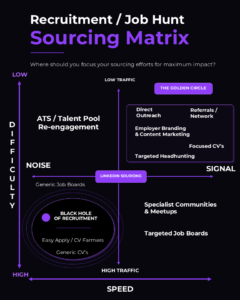
In the bottom-left sits what I call the black hole of recruitment: easy apply, generic CVs, and CV farming on general job boards. High traffic, low signal, and the hardest place to stand out. This is where most candidates default, and where most effort disappears without trace.
Moving up and right into low-traffic, high-signal territory is where the real opportunity sits. I call this the golden circle: direct outreach, referrals and network introductions, targeted headhunting, focused CVs tailored to specific roles, and employer branding that gets you on a hiring manager’s radar before you’ve even applied.
In between are channels like LinkedIn sourcing, specialist communities and meetups, targeted job boards, and ATS talent pool re-engagement. These have a role, but they work best when combined with the golden circle activity that warms up the relationship first.
The question I put to the room during the webinar: where are you actually spending your time? Most candidates are camped in the bottom-left. The smarter move is to push up and right, into the channels where the competition is lower and the signal is stronger.
The real problem with ATS systems
Applicant tracking systems were built for high-volume hiring in straightforward roles. For agile, product and delivery candidates, they are a significant barrier.
ATS systems scan for keywords, filter on criteria, and rank candidates algorithmically before a human ever gets involved. Generic CVs that list responsibilities rather than outcomes are particularly vulnerable.
During the session I pulled up a live job posting: 216 applicants within 16 hours of going live. Even in a best-case scenario, a hiring manager reviewing that list is making quick, pattern-matching decisions. Without something that immediately signals fit and impact, most applications go nowhere.
The takeaway isn’t to game the ATS. It’s to reduce your reliance on channels where ATS is the gatekeeper.
Tailoring your CV: outcomes over responsibilities
The most consistent mistake I see in CV reviews is the focus on responsibilities rather than outcomes.
Listing what your role involved tells a hiring manager what you were asked to do. It doesn’t tell them what changed because you did it. That distinction matters enormously.
Every bullet point on your CV should answer the question: so what? What got faster, cheaper, more reliable, more valuable because of what you did?
I’d recommend having multiple versions of your CV, each tailored to a specific type of role or organisation, rather than one master document sent everywhere. Each version should lead with the skills and outcomes most relevant to that context, use language that mirrors the job description, and cut anything that doesn’t directly support the case for hiring you.
On AI: use it to help structure your thinking, research companies, and identify gaps. Don’t let it write your CV for you. Hiring managers can spot generic AI-generated language immediately, and it undermines exactly the personalisation you’re trying to create.
Networking that actually works
Networking doesn’t mean attending events and handing out business cards. That approach is as inefficient as mass applications.
Intentional networking looks different. It starts with identifying the specific companies, sectors, and roles you’re targeting, then mapping out who you need to know to get closer to them. It means being present in the communities where those people spend time, contributing to conversations, and building credibility before you need anything.
LinkedIn has a role here, but it’s often misused. Rather than broadcasting that you’re open to opportunities, use it to demonstrate expertise: share perspectives on delivery challenges, comment thoughtfully on industry conversations, connect with people whose work you genuinely find interesting.
When you do reach out directly, make it specific. Reference something real about the person or their work. Ask a genuine question. Don’t lead with what you want.
People are busy. They don’t respond to generic messages. But they do respond when someone shows they’ve paid attention.
If you’ve sent a LinkedIn message and heard nothing, follow up differently. Try email. Try connecting through a mutual contact. Different channels reach people at different moments.
Searching while employed
If you’re currently employed but keeping an eye on the market, I’d suggest allocating around 5 to 10 percent of your time to passive networking. Enough to stay visible and maintain relationships without it becoming a distraction.
This means attending relevant meetups and community events, keeping your LinkedIn profile current, and staying in touch with former colleagues. The goal isn’t to actively job hunt. It’s to make sure that when the right opportunity emerges, or when someone needs to recommend a strong agile professional, your name is already in the conversation.
Building an internal profile matters too. Being known as someone with strong delivery capability and good commercial awareness within your current organisation creates options, whether that’s new projects, progression, or strong references.
Measuring your impact in agile, product and delivery roles
One of the hardest CV challenges I see is quantifying impact in roles where the work is collaborative, iterative, and difficult to reduce to a single number.
My approach: tie everything back to what the business cared about. Did the team ship faster because of how you ran the ceremonies? Did the product decisions you influenced reduce wasted development cycles? Did the way you managed dependencies keep a programme on track that would otherwise have slipped?
The key is specificity. “Led agile delivery across multiple teams” tells a hiring manager very little. “Reduced sprint carryover from 40% to under 10% across three teams by restructuring backlog refinement” tells them a great deal.
Even contributions that feel intangible can usually be grounded in something real. Time saved, waste reduced, decisions made faster, risks surfaced earlier. Think about what would have gone differently without you, and write that down.
I’d recommend keeping a running log of achievements and updating it at the end of each quarter rather than trying to reconstruct the detail when you need a new CV. The specifics fade faster than you think.
AI and the job market: what you need to know
AI is not going away, and candidates who understand it have a genuine advantage. That doesn’t mean becoming a technical AI specialist. It means being able to have a credible conversation about how AI affects delivery, what it changes about governance and prioritisation, and how you’ve used AI tools to work more effectively.
For job searching, AI can be genuinely useful for researching companies, understanding job descriptions, preparing for interviews, and identifying transferable skills. The line to hold is around authenticity: AI as a thinking partner is helpful. AI as a ghostwriter is a risk.
The goal is to sound like you, just a better-prepared version of you.
Your action plan: where to start
Here’s the framework I’d suggest for the first two weeks of a more intentional job search.
Start by defining your ideal client profile: the specific types of organisations, sectors, and roles you’re genuinely excited about and genuinely qualified for. Be specific. A list of ten well-matched targets is more powerful than applying to 100 roles without criteria.
From there, map the routes into those organisations. Who do you already know? Who could introduce you? Who should you be having a conversation with? Then start those conversations, not to ask for jobs, but to understand the landscape and build relationships.
In parallel, get your CV into shape. Pick two or three versions tailored to the different types of roles you’re targeting. Make sure every line earns its place.
And then keep going. Job searching is a process, not an event. The candidates who succeed aren’t always the best qualified. They’re the ones who stay visible, stay intentional, and don’t stop.
Want to talk it through?
I’m happy to have a direct conversation about your search or about opportunities in the agile and delivery market. Get in touch or connect with me on LinkedIn.