
Over the past twelve months, I’ve found myself returning to one question more than any other: are we at the start of something structurally different?
Not another incremental technology upgrade. Not another short-lived hype cycle. But a genuine shift in productivity and capability that changes how organisations operate and how careers are built.
As a CEO of a talent business, I sit in the flow of real hiring decisions, real budgets, and real commercial trade-offs. What I’m seeing doesn’t feel theoretical. It feels early. It feels uneven. But it also feels meaningful.
Recently, I had the pleasure of listening to Jeremy Khan, AI specialist and keynote speaker from Fortune, who described this phase of the AI revolution as the “Jagged Teeth” stage. Progress is sharp and irregular. Breakthroughs are followed by setbacks. Confidence surges, then stalls. Capabilities leap forward in one domain while lagging in another.
That framing resonated with me.
Because what we are experiencing right now does not feel smooth or linear. It feels disruptive at the edges, experimental in the middle, and quietly transformational underneath.
History tells us this pattern is not new.
Major productivity shifts rarely show up immediately in the data. Technology appears first. Excitement builds. Investment flows. But measurable gains only emerge when organisations change how work is structured, how capital is deployed, and how people are trained.
Which brings us to the lesson we keep forgetting.
AI, productivity, and the lesson we keep forgetting
There is a chart I keep coming back to.
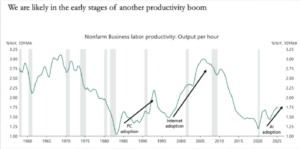
It shows US nonfarm business productivity surging from the mid-1960s to the mid-1970s, then stalling for almost two decades before accelerating again in the late 1990s as PCs and the internet became mainstream.
That chart matters because it tells us something uncomfortable: technology does not automatically translate into productivity.
The first productivity boom was not about new invention alone. It was about integration. Electricity, logistics, manufacturing scale, telecommunications. These capabilities were embedded deeply into operating models. Firms invested heavily in physical capital, redesigned workflows, professionalised management, and aligned education and skills accordingly.
Technology, capital, organisation and people moved together. That is when productivity grows.
The slowdown that followed was not a lack of innovation. The PC had arrived. Software was emerging. Data was being captured. But early productivity gains were muted because organisations layered new tools on top of old structures. Work was digitised, but not redesigned. Processes were enhanced, not reimagined.
We may be at a similar inflection point now.
AI capability is advancing at extraordinary speed. But capability alone will not deliver productivity. The gains will only show up at scale when leaders rethink how work is structured, how teams are composed, how decisions are made, and how entry pathways into careers evolve.
In other words, this moment is not just about technology. It is about organisational courage.
The long slowdown was not a lack of innovation
From the mid-1970s to the early 1990s, technology continued to advance. Computers were already in offices. Software existed. Data was being captured. But productivity stalled.
Why?
Because technology sat alongside work rather than reshaping it. Early IT lived in silos. Organisations digitised processes but rarely redesigned them. Roles remained structured around old assumptions. Capital investment slowed. Measurement lagged reality.
You could see computers everywhere, but not in the productivity statistics.
There is an important lesson here, and it is one that deserves empathy rather than criticism.
Boards and investors quite reasonably expect returns on technology investment. When significant capital is deployed into new systems or AI capability, the expectation is that productivity gains will follow quickly. That pressure is understandable.
The reality, however, is that structural change does not happen in parallel with tool adoption.
Workforce planning takes time. Business process redesign takes time. Strategy reshaping takes time. Organisations often pause, elongate hiring cycles, or delay senior appointments while they work out what their future operating model should look like.
We see this directly in our own permanent recruitment market.
Processes are extended. Roles are put on hold. Executive searches are delayed while leadership teams reassess structure, automation potential, and long-term headcount design. It is not a lack of ambition. It is a period of recalibration.
This is what transition looks like.
The risk is not that AI fails to deliver. The risk is assuming the returns should appear before the redesign has happened.
PCs ultimately delivered productivity gains not because they existed, but because organisations eventually rebuilt around them. Computing moved from back offices onto desks. Processes were re-engineered. Data flowed across functions. Decision-making sped up. Networks mattered more than hardware.
The lesson is simple: productivity gains arrive after redesign, not after adoption.
PCs worked because organisations changed
The productivity pickup of the late 1990s did not happen because PCs were invented. It happened because firms had the discipline and courage to reorganise around them.
Computing power moved from back offices onto desks. Processes were rebuilt. Data flowed across the organisation. Coordination costs collapsed. Decision-making sped up. Networks mattered more than hardware.
The lesson is simple. Productivity gains arrive after redesign, not after adoption.
This is the uncomfortable truth about AI
AI feels different because adoption is faster and the tools are more powerful. But the structural risk is exactly the same.
Most organisations today are experimenting at the edges. Drafting support. Search. Summaries. Copilots embedded into existing workflows. Productivity pilots in pockets of the business.
That is progress. But it is not transformation.
From what I see across our clients, the real hesitation is not about the technology. It is about what follows. Redefining roles. Rethinking workforce plans. Reworking incentives. Deciding which layers of decision-making still make sense in an AI-assisted environment.
Just as in the 1970s and 1980s, the real gains will only appear when businesses redesign how work is done. How decisions are made. How data flows. How roles are defined. How performance is measured. How incentives are aligned.
AI will not deliver productivity by sitting next to broken processes.
Live coding, Codex, and the ERP question
Where this becomes particularly interesting is in software development itself.
The emergence of live coding environments and increasingly capable systems such as Codex raises a more structural question. If AI can meaningfully accelerate development cycles, reduce dependency on large outsourced teams, and enable rapid iteration, what does that mean for traditional ERP-heavy operating models?
We may see organisations gradually unshackling from highly customised, multi-year transformation programmes and instead bringing more development capability back on-site. Smaller, more agile internal teams augmented by AI. Faster experimentation. Reduced reliance on long change cycles.
We are also seeing the early signs of something even more disruptive: the rise of the single-person software company. Individuals now have access to tools that allow them to design, build, test and distribute full software products with minimal overhead. What once required a team of ten may soon be achievable by one.
We do not yet know how far or how fast this will go. But it challenges long-standing assumptions about scale, team size, and the economics of software creation.
What this means for service businesses
For professional and service-based organisations, the parallel is stark.
Buying AI tools is relatively easy. Embedding them into core workflows is where the real work begins.
The opportunity is not marginal efficiency. It is structural change. Reimagining how demand is forecast. How pricing decisions are made. How talent is matched. How delivery is optimised. How time is genuinely freed up for higher-value work rather than absorbed by new layers of coordination.
The constraint is rarely the technology. It is data discipline, process clarity, and organisational will.
The leadership moment
History is clear. Productivity follows redesign, not invention.
If this really is the start of another structural shift, three things matter more than anything else.
1. Embed AI at the core.
It must sit end-to-end in the operating model, not bolted onto the edges.
2. Redesign work around what is now possible.
Roles, workflows and incentives should reflect AI capability, not legacy assumptions.
3. Treat data as infrastructure.
Clean, shared, trusted data is not optional. It is the capital base of the AI era.
If we get this right, AI may well power the next productivity expansion.
If we do not, we will repeat a familiar story. Powerful tools. Ambitious expectations. Modest aggregate results.
The difference will not be the technology.
It will be the decisions leaders make now.